1. Introduction
Water quality is a major concern in India today. With rapid urbanization, industrial growth, and increasing population, the demand for water has grown significantly. Unfortunately, the quality of available water has not kept pace with this demand. Many households and businesses depend on different water sources such as borewell water, tanker supply, river water, and municipal water, each of which comes with its own set of challenges.
In several parts of the country, borewell water is high in minerals, tanker water is often untreated, and river water may carry industrial or domestic waste. Even municipal water, which is treated by local authorities, may not always meet safe drinking standards by the time it reaches homes due to old pipelines and contamination.
Poor water quality affects not only human health but also daily life and business operations. It can cause health problems like stomach infections and skin irritation. It can damage appliances such as geysers, washing machines, and boilers. For industries, poor water quality leads to higher maintenance costs, production issues, and regulatory risks.
Understanding common water problems and their solutions is the first step towards ensuring clean drinking water and safe water usage.
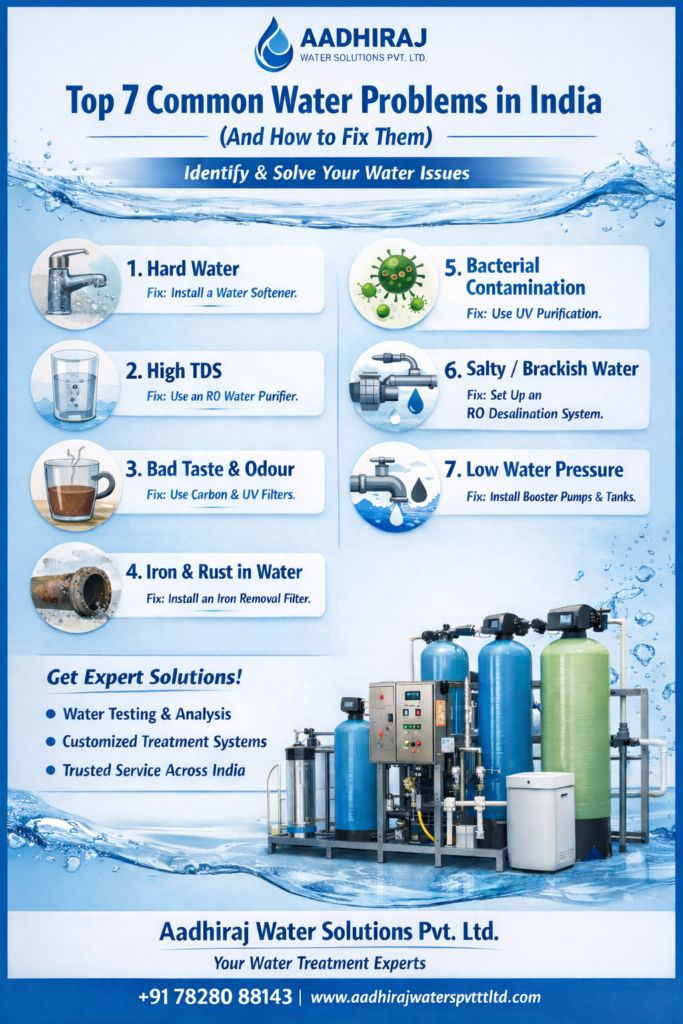
2. The Top 7 Common Water Problems in India
1. Hard Water
What it is:
Hard water contains high levels of calcium and magnesium.
Common causes in India:
Mostly found in borewell and groundwater due to mineral-rich soil.
Effects:
- Scale buildup on taps and pipes
- Reduced life of appliances
- Dry skin and hair
- Poor performance of soaps and detergents
2. High TDS (Total Dissolved Solids)
What it is:
TDS refers to the total amount of dissolved salts and minerals in water.
Common causes in India:
Groundwater, industrial discharge, and high mineral content.
Effects:
- Salty or bitter taste
- Digestive issues
- Not suitable for drinking at high levels
3. Bad Taste and Odour
What it is:
Unpleasant smell or taste in water.
Common causes in India:
Organic matter, chlorine, decaying material in pipelines, or bacteria.
Effects:
- Water becomes unfit for drinking
- Reduced water intake
- Poor cooking quality
4. Iron and Rust in Water
What it is:
Presence of iron particles in water.
Common causes in India:
Old pipelines, borewell water, iron-rich soil.
Effects:
- Yellow or reddish stains
- Metallic taste
- Staining on clothes and utensils
5. Bacterial Contamination
What it is:
Presence of harmful microorganisms.
Common causes in India:
Sewage leakage, poor sanitation, contaminated storage tanks.
Effects:
- Waterborne diseases
- Diarrhea, typhoid, cholera
- Serious health risks
6. Salty / Brackish Water
What it is:
High salt content in water.
Common causes in India:
Coastal regions, deep borewells, seawater intrusion.
Effects:
- Not suitable for drinking
- Corrosion of pipes
- Damage to crops and plants
7. Low Water Pressure or Inconsistent Supply
What it is:
Irregular or weak water flow.
Common causes in India:
Old infrastructure, poor storage, leakage, seasonal shortages.
Effects:
- Disruption in daily activities
- Inadequate water availability
- Pressure on alternative sources
3. How to Fix These Water Problems
Hard Water
Solutions:
- Install a water softener for homes and apartments.
- Use commercial softeners for hotels and hospitals.
- Industries should use advanced softening plants.
High TDS
Solutions:
- Use RO systems for drinking water.
- Large RO plants for offices and factories.
- Industrial RO plants for manufacturing processes.
Bad Taste and Odour
Solutions:
- Activated carbon filters
- UV/UF purifiers
- Regular tank cleaning
Iron and Rust
Solutions:
- Iron removal plants
- Oxidation and filtration systems
- Replace old pipelines
Bacterial Contamination
Solutions:
- UV disinfection systems
- Chlorination
- STP (Sewage Treatment Plant) for buildings
Salty / Brackish Water
Solutions:
- RO desalination plants
- Brackish water treatment systems
- ZLD for industries
Low Water Pressure
Solutions:
- Booster pumps
- Storage tanks
- Leak detection and repair
Domestic vs Commercial vs Industrial Systems
- Domestic: Small RO units, softeners, UV purifiers.
- Commercial: Medium RO plants, STPs for apartments and hotels.
- Industrial: Large RO, ETP (Effluent Treatment Plant), ZLD systems.
4. How to Identify Your Water Problem
You can identify water issues through simple signs:
- White scale on taps → Hard water
- Yellow stains → Iron
- Bad smell → Bacteria or organic matter
- Salty taste → High TDS
- Cloudy water → Contamination
Importance of Water Testing
Water testing helps determine:
- TDS level
- Hardness
- Iron content
- Bacterial presence
Professional water analysis provides accurate results and helps select the right treatment solution.
5. Benefits of Solving Water Problems
- Better health: Safe drinking water reduces disease risk.
- Longer appliance life: No scaling or corrosion.
- Improved taste and hygiene: Better cooking and bathing.
- Reduced maintenance cost: Fewer breakdowns and repairs.
- Compliance for businesses: Meets environmental regulations.
6. Conclusion + Company CTA
Ignoring water problems can lead to serious health risks, higher expenses, and long-term damage. Investing in the right water treatment solutions ensures clean water, protects appliances, and supports sustainable living.
At Aadhiraj Water Solutions Pvt. Ltd., we specialize in providing customized solutions such as RO plants, water softeners, STP, ETP, iron removal systems, and industrial water treatment solutions. With years of expertise and a customer-focused approach, we help homes and businesses across India achieve safe and reliable water systems.
If you are facing water quality issues, trust Aadhiraj Water Solutions Pvt. Ltd. to deliver professional and affordable solutions for a healthier future.